IT’S STILL ALL ABOUT FEES - AND THE NUMBERS BEHIND THE CLAIMS

Small differences in fees can take a significant bite out of retirement returns, with fund costs ranging from 0.81% to almost 3% a year.
I hate regurgitating the same topic over and over again. Unfortunately, there are companies that know how to grab the attention of investors and then ride the emotional rollercoaster to lure clients into investing in their funds.
When I broached this topic in a previous article, the company that I named complained to the editor of Moneyweb. I assume the same is going to happen this time.
Since the information that I will publish in this article is available in the public domain and can be accessed via Morningstar and various other publications, there is no harm in naming actual funds and companies.
In a recent newsletter published by 10X, they refer to the various layers of fees and at least five different ways that fund managers declare fees. Nothing wrong with that since this is based on factual information.
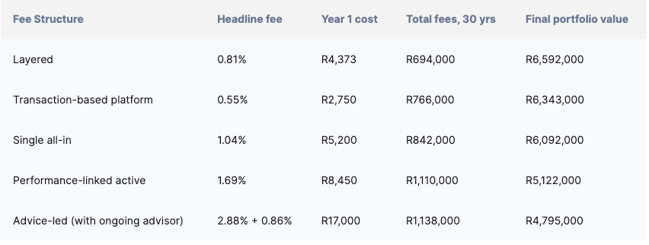
They then continue to illustrate the outcome of returns on an investment (in a multi-asset retirement annuity) where fees are charged at a range from 0.81% per annum to almost 3% per annum. Nothing wrong with that. The illustration is copied from their newsletter and shown below.
The 30-year projection
So, what is my gripe, you may ask. Nothing, if we consider the same portfolio providing the same return. However, investing is not that simple. Different funds have different returns.
Many people believe that the higher the fee, the lower your returns will be. This simply is not true. The perception that performance fees further erode returns is also not factual.
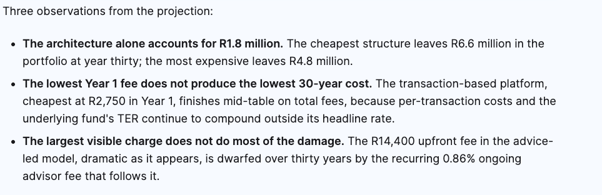
In the illustration above, the most expensive option is where a financial advisor is used. This option also results in the worst outcome, with an investment value of R4 795 000 after 30 years.
This is where I have a problem with the 10X marketing strategy. In a similar way to another “passive-low-cost” manager who regularly points out that more than 70% of SA fund managers fail to beat their benchmark but conveniently omits the fact that 100% of index funds (passive funds) fail to beat their benchmark, 10X does not qualify its statement by acknowledging that fund returns matter more than fees.
The value of advice goes beyond fees
It also doesn’t compare its fund returns to the fund managers whose fees it quotes in its newsletter. Both companies rely on a simple statement: The lower the fees, the better the returns, and investors buy it. Now its statement says that by using a financial adviser you are guaranteed to get less.
10X’s reference to the “cost of the advisor fee” implies that financial advisors add no value to the financial lives of investors. The value-add comes in many forms, not just an attempt to achieve better returns, but that is a different discussion.
Let me shed some light on the facts about fees and the returns of the prime fund of 10X, the Your Future Fund and compare it to other mainline funds in the sector.
This fund falls squarely in the retirement annuity (RA) space under the Multi-Asset High Equity sector that they refer to in their example. This is a good fund, and this comparison is not an attempt to de-merit the fund.
The information in the graph below is published by Morningstar, among others, and can be verified in various publications. The managers also have fund fact sheets available that anyone can Google and download from their websites. The same applies to the 10X fund.
In my illustration, I used some well-known funds which we often use as part of our solution.
In client portfolios, we generally add specialist offshore funds as well as specialist equity and income funds to structure a more complete investment solution.
We construct portfolios on a bespoke basis, based on specific client needs and risk tolerance. For this exercise, however, I will stick with the four funds that often form the core of our RA investment solutions since this is the sector 10X referred to. Observe the following returns and fund rankings.
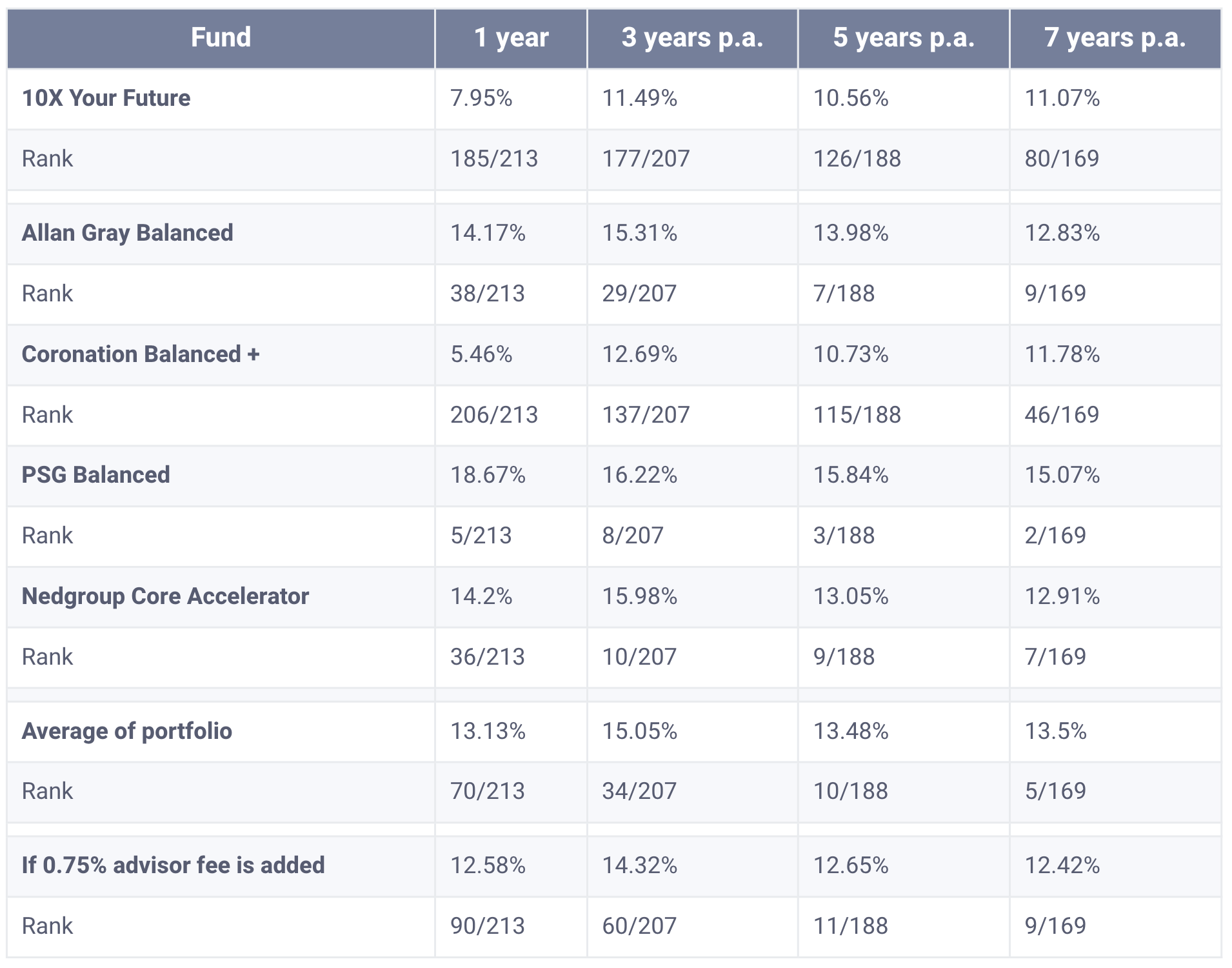
As shown above, the solution using the four funds outperformed the 10X fund by a healthy margin across all periods, even when an advisor fee of 0.75% is added.
In their own words, a small fee difference can become a big difference. Over 30 years, an additional 1.4% return per year can increase a R1 000 000 investment from R17 449 402 to R25 500 912 if a return of 11.4% is achieved instead of 10% per year.
And then there are performance fees…
Another red herring is performance fees. In my view, performance fees are not inherently bad, as long as they are clear, understandable and fair.
In the example above, Allan Gray Balanced Fund does charge a performance fee. All the returns shown are net of performance fees and trading costs. Investors often believe that management fees must still be deducted from the published returns.
Where funds are invested via a platform and an advisor is used, the administration cost and advisor fees must be deducted from published returns.
Where platforms are used, the investment statements do report on these costs.
Also note that fees can be negative when performance fees are charged. This is shown below. For the Orbis Equity Fund, a very high fee of 4.24% is currently charged, but the fund still provided a return of 33.4% after fees in USD over the past year.
Both the Orbis Emerging Markets and Japan funds underperformed their benchmarks, resulting in negative fees. I believe this is a fair deal.
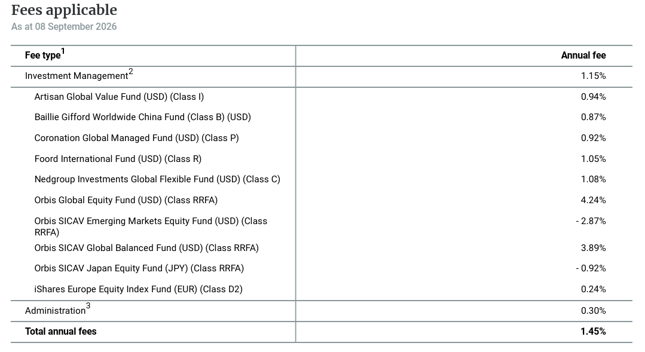
As shown above, this is a diversified portfolio with a wide range of funds, some of which appear ‘expensive’ at face value. However, the overall fund manager fee is 1.15%, which is low for an actively managed fund. Please don’t take this as investment advice. It is merely a demonstration of fees.
In conclusion, my question is: Would you like to pay a 1.0% management fee per year on your R1 million investment and, after 30 years, receive back R23 329 377 or
Pay a 1.85% management fee per year and receive back R37 884 465?
I don’t know anyone in retirement who received less than their friends, who boast: “Yes, I have less than you, but I paid lower fees than you.” Lower fees do not pay the bills…
On the flip side, higher fees do not guarantee you better returns. Be sensible and understand what you invest in. Make sure that what is written on the box is actually inside.
Take care and invest wisely.
