
THE 5 PILLARS OF RETIREMENT (OR IS IT 10?)

Few people thrive in retirement by chance. A fulfilling retirement is built over many years with Spiritual, Mental, Physical, Social and Financial well-being working together to support your life beyond work.
How will you know if you are thriving in retirement?
I recently had to extend my studies to maintain my accreditation as a Certified Professional Retirement Coach. The study material is designed to promote a more modern approach to retirement.
Being a certified financial planner first and foremost, I often have to tear myself away from the analytical and technical side of retirement planning and remind myself that the technical and financial side of retirement, albeit a very important part of it, is only one wheel in the coque of retirement.
During my studies, I was reminded again of how intertwined different areas of one’s life and psyche are, and how one’s life can change if these important areas fall out of balance. Even a small change can have a domino effect, altering a person’s retirement.
Previously, I wrote about using Positive Psychology and applying the PERMA principle to achieve a fulfilling retirement. As a quick reminder, PERMA stands for:
P = Positive Emotion (Experiencing joy, gratitude, hope and love)
E = Engagement (Being engaged in a state of “flow” during tasks)
R = Relationships (Building and maintaining strong relationships)
M = Meaning (Having a sense of purpose and feeling that your life serves something larger than yourself.
A = Accomplishment (Celebrating your personal and professional accomplishments)
Instead of elaborating on PERMA, I would like to introduce you to the ‘other’ five pillars of retirement. These pillars should not be seen as a replacement for PERMA, but rather as an enhancement.
When used alongside PERMA, the two strategies can have a meaningful impact on people close to and in retirement. Get this right, and you have a much better chance of experiencing a fulfilled retirement.
One point before I start.
Many people leave retirement planning (not the money side, but the life side) until just before “the big day”.
A fulfilled retirement can only be achieved if preparation starts many years before retirement. Hopefully, the information I provide here will illustrate the importance of balance and preparation.
Like everything else, one needs to work at it to achieve a successful retirement.
How many people manage to retire and thrive in retirement?
Can you think of a person you know who has made a positive transition from work to home life? If so, how did they achieve that? Think about the specific things that make them appear successful in this new phase of life.
I won’t be surprised if many cannot pinpoint anyone. Few people find the right balance for a happy, fulfilled retirement. Like a building built on columns or pillars, if only one pillar shows cracks, the others are weakened.
I would like to introduce you to the five pillars that underpin a fulfilled, happy retirement.
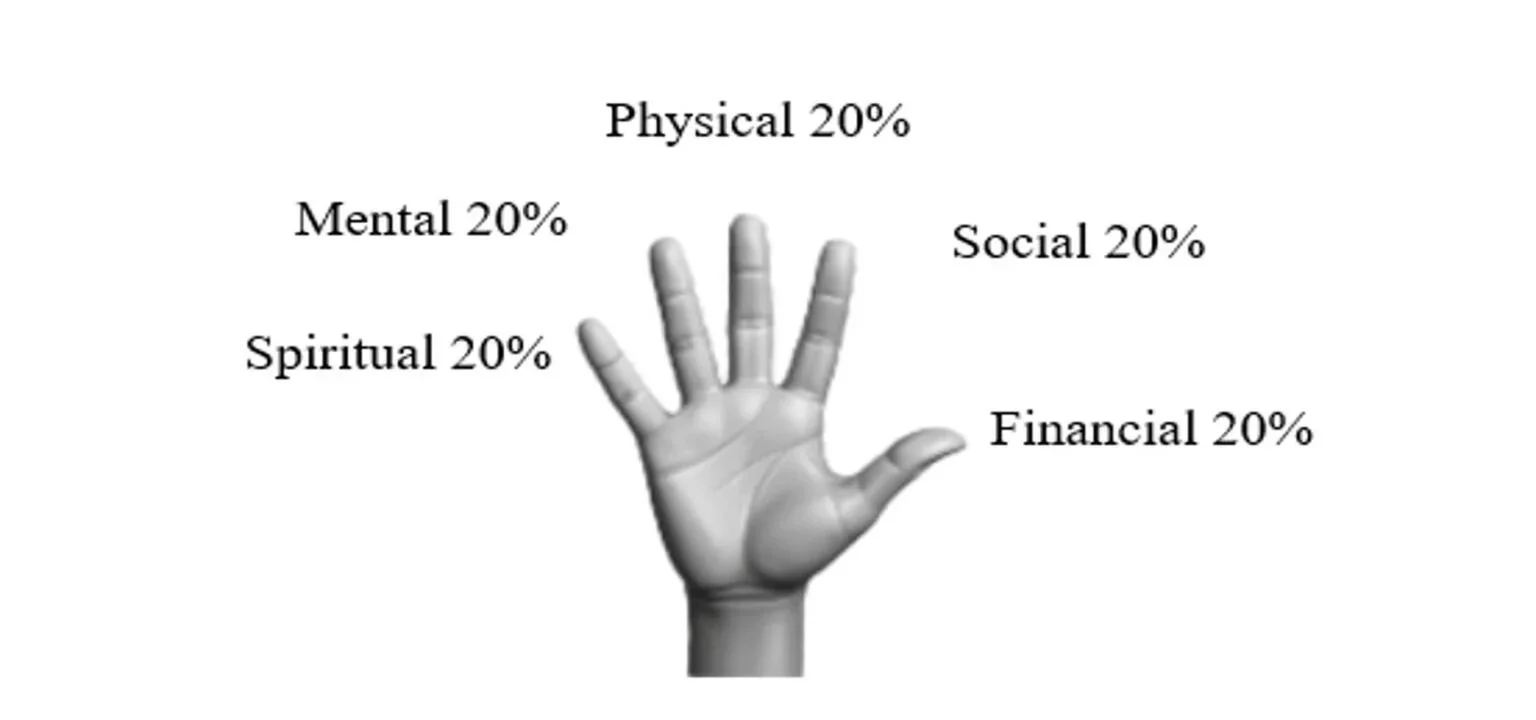
The key pillars are Spiritual, Mental, Physical, Social and Financial. These pillars can be visualised as the supporting pillars of a building or as the fingers on your hand.
Each of the five pillars represents 20% of equal importance. It is important to note that the five pillars (or fingers) are deeply interconnected and should not be considered in isolation. They function as a living system. When one finger breaks, the others are weakened and struggle to function.
The more fingers break, the more dysfunctional the hand becomes. If we relate this to retirement or to life in general, we note that when social connection declines, mental health often follows.
When physical health deteriorates, confidence and identity are affected. When values are unclear, decision-making becomes harder across every domain.
This is why retirement struggles rarely manifest in a single area. A holistic and comprehensive plan doesn’t just balance and stabilise the pillars; it recognises how deeply interconnected they are.
Clients who enter retirement with only a financial plan have addressed just 20% of the retirement conundrum. The other 80% remains unresolved.
Those who have maintained a balanced life prior to retirement will find the transition easier than those who neglected some of the pillars. As I mentioned, retirement preparation starts long before “D-day”.
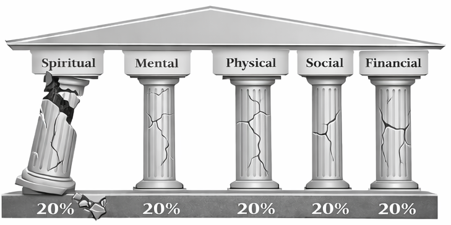
If one considers the five pillars, one will notice that this reflects normal life. Every person is subjected to spiritual, mental, physical, social and financial challenges, irrespective of age. Nothing new here. The challenge is balance.
Many of us overemphasise some of the pillars at the expense of the others. It may be that the financial and physical pillars appeal more to you in your younger years. This may be at the expense of the social and spiritual pillars. This can also be vice versa.
The challenge is that if you enter retirement with your foundation full of cracks, fixing it becomes very difficult. Years of habits are hard to break. If you neglected your physical health, it is hard to repair.
If you were socially difficult throughout the years, it is hard to change your personality and make friends. All these pillars are equally important. Imbalance can and probably will cause weakness elsewhere.
Let’s explore each pillar.
Pillar 1: Spirituality
In the illustrations above, spirituality is shown first. This is not a coincidence because the combination of our values and beliefs influences our thoughts and behaviours. I would like to clarify spirituality in this context.
Internal Spirituality: Living in alignment with one’s personal values. It carries no religious connotations and does not require belief in a higher power.
External Spirituality: Focuses on an outward essence, which may be a higher power, humanity, nature, or the universe. This may be taboo for some, but others may find a way to deal with emotional ups and downs here.
In retirement coaching, we focus more on Internal Spirituality.
We use the term spirituality to mean: the core values and deepest beliefs that define who a person is and form the foundation for how they process things, make decisions, and live.
In short, internal spirituality determines your values, purpose and integrity. Internal spirituality will ultimately determine how successfully you approach the other four pillars and whether you will thrive in retirement.
Walt Disney is famously quoted as saying, “When your values are clear, your decisions are easy.”
Pillars 2 + 3: Mental + Physical
Once values are clear and beliefs have been affirmed, we can focus on thought patterns, perceptions, and attitudes towards retirement. This naturally leads to a discussion of physical needs and well-being (overall health, longevity, healthcare costs, the impact of ageing) and how these factors affect the things a person wants or desires in retirement.
Retirement is different from life before retirement. When we were in school, at university or at work, we knew what was expected of us and what it took to move through it successfully.
We also know what to do to succeed in our marriage or as parents, and what it takes to stay healthy and active.
Retirement, however, is often conceptualised as a period of rest, fun, and leisure, rather than as a measurable phase that requires mental and physical effort, strategies, and even lifestyle achievements.
Remaining mentally and physically fit and strong ensures that you can stay active and participate in daily activities for many years. Mental exercises are as important as physical exercise. Let this slip, and old-age ailments will creep up on you much faster than necessary.
Pillar 4 + 5: Social + Financial
Part of every person’s well-being needs to include people. Social networks are important, and in retirement this becomes even more relevant. You will rely on your fellow retirees and friends much more than when you were working.
Often, children and family members have moved on and are not in close proximity to you. Friends and fellow retirees almost become extended family, and you may have to rely on them sometime in the future.
They, in turn, will rely on your support too. Whether you are an introvert or an extrovert will determine how you interact with other people in retirement.
It is also a good idea to mend broken relationships. Be the better person and reach out first.
Enough has been written about the importance of financial readiness in retirement, but it is important to have enough resources to support and sustain the other four pillars.
The five pillars align naturally with fundamental human needs:
Values and beliefs are the grounds for decision-making.
Mental and physical health support daily functioning.
Social connection provides belonging and relevance.
Financial security offers stability and choice.
So how do we know if someone is thriving in retirement, and what will make a person feel successful if the transition aligns with the five pillars? People tend to feel positive and optimistic about their transition if they have found a way to:
Live life according to their values and beliefs
Replace their work identity with meaningful roles and tasks
Stay connected and relevant
Keep mentally fit and physically active
The above is achievable by most people. However, working towards a successful and thriving retirement is much easier the sooner you start planning. We all start planning for retirement financially; why don’t we add the other four pillars to our retirement plan?
Plan well and thrive in retirement – start now, not when you are 65.
