
YOU ARE MORE THAN WHAT YOU DO: A REFLECTION ON WOMEN AND SELF-WORTH

A thoughtful reflection on self-worth, reminding women that their value is not defined by achievement, productivity or the roles they fulfil.
Every year we rightly take a moment to acknowledge and celebrate women.
In South Africa, the day carries particular significance. On 9 August 1956, around 20 000 women marched to the Union Buildings in Pretoria in protest against the pass laws. It was an extraordinary demonstration of courage, conviction and determination. Seventy years later, Women's Day remains an important opportunity to recognise the contribution women make in our families, workplaces, communities and country.
A consideration before I go further: I'm writing this as a man, watching from the outside rather than living it. So take what follows as an observation offered with respect. And yes, without fail there will be that one man that will ask the question "why don’t we have a men's day?" And, of course the response is; every day is a “man's day.” Jokes aside, this year, as I look at the women around me, I find myself thinking about something a little different.
I wonder whether many women have become so accustomed to pushing themselves that they have forgotten to stop and recognise their own value.
Not because they aren't capable. Perhaps, in some cases, it is precisely because they are so capable. They build careers, raise children, manage households, care for parents, support partners, and maintain friendships. Carrying responsibilities that are sometimes visible and sometimes completely unnoticed. And then, somehow, they find themselves wondering whether they are doing enough.
Perhaps the question isn't always, "Can I do more?"
Perhaps sometimes the better question is: "Why do I feel like I need to?"
What exactly is self-worth?
Self-worth is a term we hear regularly, but it is worth stopping to consider what it actually means. The American Psychological Association defines self-worth as an individual's evaluation of themselves as a valuable and capable human being who deserves respect and consideration. There is something really important in that definition. Self-worth isn't primarily about achievement; it's not about being the best employee, the perfect mother, the most successful career, or having the nicest home or the most impressive social media feed. Those things may be meaningful, and there is nothing wrong with ambition or achievement. But they are not the foundation of your worth.
What you do and who you are, are not the same thing. And I think this is something many women need to be reminded of.
The pressure to keep pushing
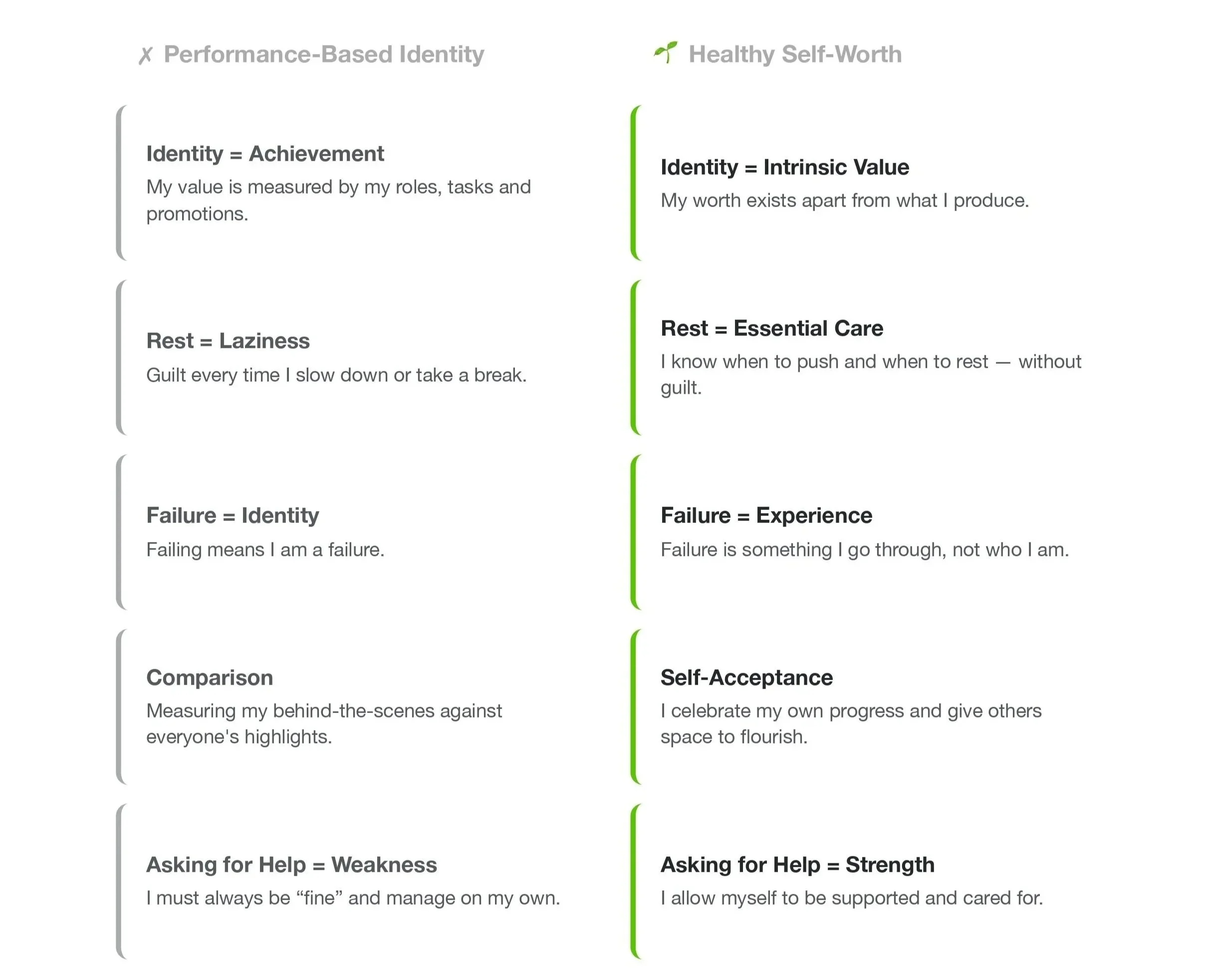
There is nothing inherently wrong with ambition, or with wanting to build a career, provide for your family or pursue a dream. The problem comes when achievement quietly becomes the measure of identity, when "I want to achieve" becomes "I need to achieve in order to feel valuable." When rest feels like laziness. When asking for help feels like failure. When saying no produces guilt. When one more achievement is always required before you can finally tell yourself, "I've done enough."
The finish line keeps moving. You get the promotion, and then you need to prove yourself in the new position. You get the qualification, and there's another goal. Your children reach one milestone, and suddenly there's another concern. You get the house organised, and it needs doing again next week. There is always another mountain, and eventually a person can become incredibly productive while simultaneously feeling like they are never enough. That is not healthy self-worth.
You don't have to earn your value
One of the greatest misconceptions we carry is that our value has to be earned. We earn money, promotions, qualifications, and trust. But we don't earn our worth. There's a difference. Your achievements tell a story about your abilities and perseverance, but they don't determine your value as a person.
You were valuable before the promotion, before you became a mother, before anyone recognised what you could do. And you remain valuable when you fail. That doesn't mean failure doesn't matter, or that we shouldn't take responsibility for our mistakes. It simply means failure is something you experience, it is not who you are.
The comparison problem
Self-worth also becomes difficult when we constantly compare ourselves with other people, and we've never had more opportunities to. Social media gives us access to carefully curated versions of other people's lives; the career success, the beautiful family photos, the seemingly perfect relationships. Then we look at our own messy kitchen, unfinished projects and tired body and wonder why we don't have it all together. But we're comparing our behind-the-scenes with somebody else's highlight reel. It's an impossible competition, and another woman's success, beauty or motherhood doesn't diminish yours. There is room for someone else to flourish without you falling behind.
The woman who is always "fine"
There's another woman I think about, the one who is always fine. "I'm good." "Don't worry about me." "I've got it." She may genuinely be strong and capable. But sometimes strength becomes a disguise for exhaustion, and being the person everyone relies on means nobody notices when you need someone to rely on. Sometimes self-worth looks like allowing yourself to be cared for: saying "I need help," admitting you're tired, taking a break without guilt, and recognising that your value doesn't decrease simply because your capacity has.
You are more than your roles
One of the dangers of life is allowing our roles: mother, wife, daughter, business owner, manager, caregiver becoming our entire identity. All of these roles matter, but none of them fully define you. There may come a day when your children leave home, your career changes, or your responsibilities decrease. And when that happens, you don't want to discover that you've lost yourself because the role you built your identity around has changed.
Healthy self-worth gives you something deeper to stand on. It says: "I am more than what I currently do."
So what does healthy self-worth look like?
It doesn't mean becoming arrogant, or refusing to acknowledge your weaknesses, and it certainly doesn't mean stopping your ambition. It's much quieter than that. It's recognising your strengths without needing constant applause. Accepting the reality of your weaknesses without letting them define who you are. When it comes to criticism, receiving it without feeling your whole identity has been attacked. Knowing when to push and when to rest. Saying no without believing you've disappointed everyone, which is a big one of managing expectations. Celebrating progress instead of only seeing what's unfinished. And probably the most important, is learning to separate worth from performance.
A short exercise: Take stock, don't keep score
You don't need to answer these out loud, or even write them down. But if you want to, take five minutes with a notebook and sit with them honestly.
What have you carried this year that no one applauded, but that mattered anyway?
When did you last say "I've got it" when what you actually needed was help?
Name one thing you accomplished recently and notice how quickly your mind jumped to what's next, instead of letting yourself feel it.
If every role you hold as professional, partner, mother, caregiver etc disappeared tomorrow, what would still be true about who you are?
Whose life have you compared yourself to this week and what part of their story were you actually seeing?
What would you say to a friend who described her week exactly as you'd describe yours?
There's no scoring here, and no right answers. The point isn't to measure yourself against these questions, it's to notice, for a few quiet minutes, what's already there.
A challenge for women, and perhaps for the men around them
So, to the women reading this: possibly the challenge isn't to do more. Perhaps it's to stop occasionally and recognise what's already there; what you've carried, what you've learned, the challenges you've survived, the people you've influenced, the things you've built. And remember that even if tomorrow all of that changed, you would still have value.
And perhaps there's a challenge here for the men as well. If you're a husband, father, brother, friend, colleague or leader, don't only notice what the women around you have accomplished. Notice them.
You don't have to prove that you are enough
Women's Day is about remembering the women who stood together and made their voices heard. That history should be honoured. But another kind of courage is required today: the courage to step away from the endless pressure to prove yourself, to rest, to ask for help, to say no, to stop comparing, and to accept that you're still growing and don't have to have everything figured out. Above all, the courage to believe that you are worthy of respect and consideration, not because you have achieved, given or sacrificed enough, but because your worth is deeper than all of those things.
So, to the women who keep pushing, achieving, caring and carrying: keep pursuing what matters to you. Keep growing. Keep dreaming. But don't confuse what you accomplish with what you are worth. You don't need another promotion, another qualification, or anyone else's validation to become valuable. And you don't need to carry the whole world on your shoulders to prove that you are strong.
Sometimes the healthiest thing you can do is stop, take a breath, and recognise something that was true before you achieved anything at all: you have value.
