
THE SIX TYPES OF WEALTH – PART 3: MENTAL WEALTH
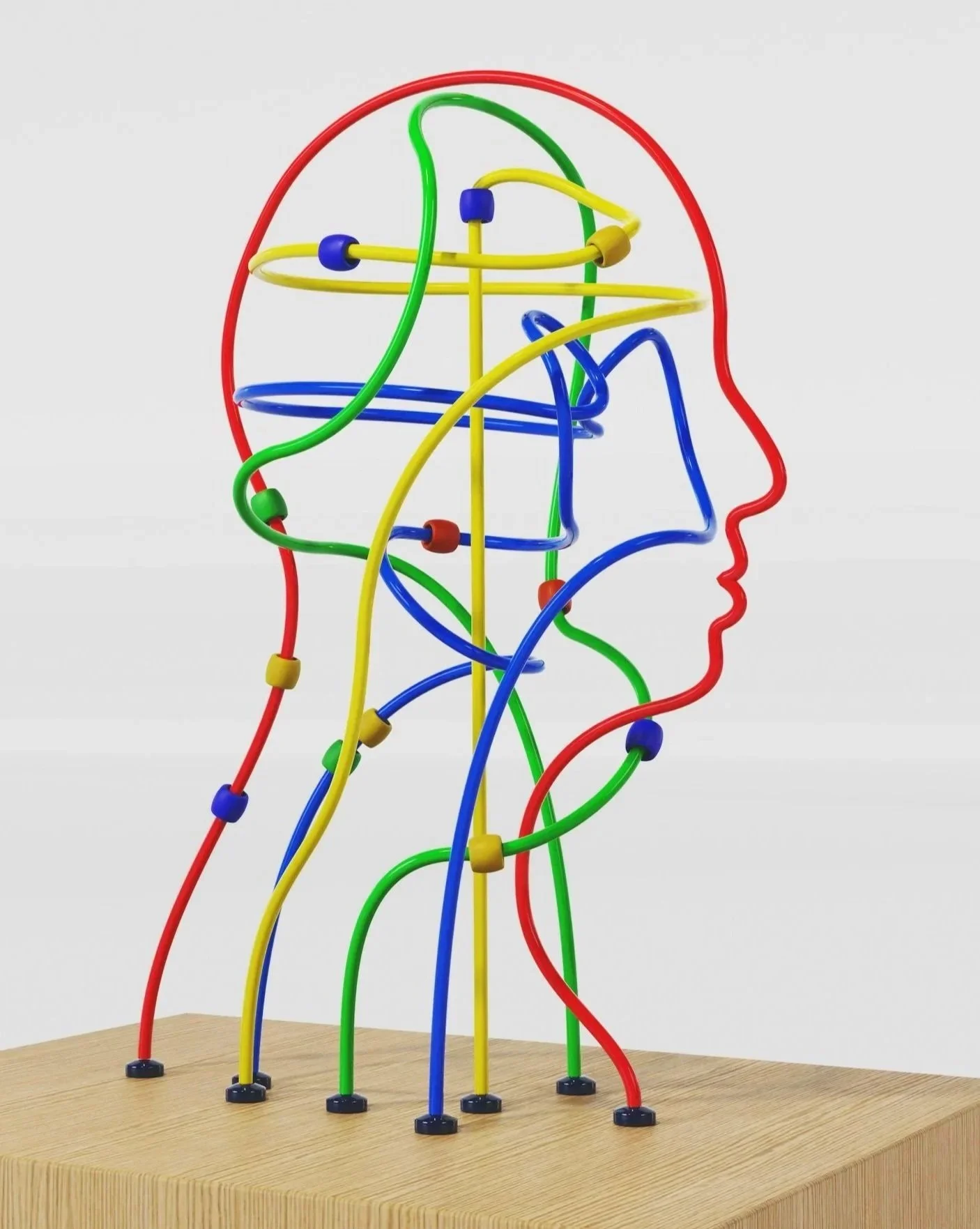
Mental wealth is often the most taboo to discuss, yet it influences every decision, interaction, and outcome in your life.
In my previous articles about the six types of wealth, I covered Time Wealth and Social Wealth. It is important to understand that all the different types of wealth are interconnected, and to achieve your “dream life”, all six types of wealth must be in balance and work together harmoniously.
It is better to have three of the six synchronised with one another than not to achieve wealth in any of them, but ideally, in order to flourish, all six need to be dealt with successfully. However, we know that life does not always present us with perfect opportunities to achieve ideal solutions; therefore, everyone must deal with the hand they are dealt.
As soon as one mentions mental health or mental wealth, eyebrows begin to lift. Often, discussing mental challenges is considered taboo. However, as humans, we are affected by our mental well-being daily. If our mental state is challenged, it impacts how we think, how we react, how we interact with others and how we invest. We cannot ignore the importance of mental wealth or mental health. In this article, I will focus mainly on Mental Wealth.
Curiosity is the fountain of a life of mental wealth. It’s also part of everyone’s DNA, you are literally born with it. If you want to experience real curiosity, spend some time with children who pursue everything with enthusiasm and fearlessness (sometimes to their own detriment, but that is how they learn). Curiosity is how you learn about the world and how you stay alive.
A 2018 study found that the brain systems that are engaged by curiosity contribute to maintaining cognitive function, mental health, and physical health with age. Curiosity has been connected to higher levels of life satisfaction and positive emotions and lower levels of anxiety. Curiosity keeps us happier, healthier, and more fulfilled.
Mental wealth is about building on the foundation of curiosity that encourages you to search, explore, question and learn. It is through curiosity that you go on your journey to uncover and live by your purpose, unlock new insights and lifelong growth, and seek out the space necessary to think, reset and recharge. Fortune favours the curious.
Regrettably, as we age, we often lose our childlike curiosity. It takes a backseat to busyness and ‘stuff’ as we grow older. Daily life prevents us from exploring and discovering new things. Is it that, as we mature, we see less value in acting on curiosity because of our perception of time’s worth? (Perhaps it’s just us becoming wiser and worrying that our endless curiosity might kill us as we push into wider and wilder limits!)
The desire to be curious lessens in our 20s and 30s as we stop exploring interests and hobbies outside our careers. It further decreases in our 40s and 50s when we stop trying to understand the world and simply accept “that’s just the way it is.” In our 60s and 70s, we stop learning new things because we no longer see the benefit in doing so.
Most people have lost touch with their inner 10-year-olds – but it’s not too late to reconnect.
So, what would your 10-year-old, hyper-curious, mischievous self say to you today?
Would he/she be excited about what you experienced on your journey leading up to today, or would he/she show resentment that you settled for less than what you deserve?
Would that 10-year-old be impressed by your passion for ongoing growth, development, and learning?
Would that 10-year-old shudder at the lack of space, stillness, and silence in your life?
Your 10-year-old self would remind you to stay curious about the world and enjoy yourself along the way.
Throughout history, the pursuit of purpose, growth, and reflection has been a fundamental aspect of the human experience. This pursuit manifests in various forms across numerous ancient cultures.
In ancient Hindu traditions, the concept of dharma signifies one’s sacred duty – the life purpose that guides an individual through the unknown with bravery and courage.
In ancient Greece, the concept arete was used to convey the idea of realising one’s full potential and purpose.
In Buddhist teachings, the “Noble Eightfold Path” is divided into three categories: wisdom (right view, right resolve, right speech), ethical conduct (right action, right livelihood, right effort), and mental discipline (right mindfulness, right concentration). The Noble Eightfold Path is a lifelong journey that offers practitioners a clear purpose and guidance for their daily practice.
The Okinawans of Japan refer to ikigai, which means “a reason for life” – a motivation for their daily energy and vitality. Ikigai can be visualised as shown below, where four circles overlap.
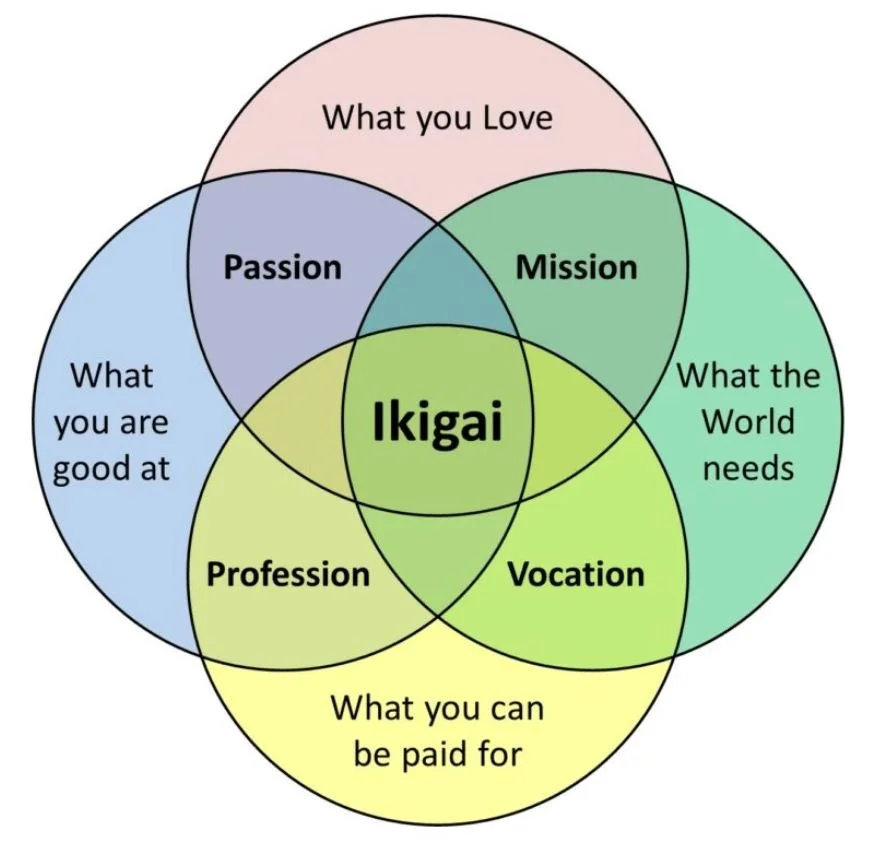
Where they overlap you achieve harmony and a balanced life. You achieve ikigai.
Ikigai’s circles can easily be modelled to illustrate harmonious wealth. If we maintain balance and purpose in our lives, we are well on our way to achieving a high level of mental wealth and living a fulfilled, flourishing life.
The three pillars of mental wealth
Purpose: Living your life. Your purpose doesn’t need to be vast or significant to others – it just needs to be yours.
Growth: Chasing your potential. Explore new interests and hone newly acquired skills. Strive to reach your full potential – it’s a rewarding lifelong challenge that keeps you sharp and shows your ability to change, develop, and adapt.
Space: Discover your own haven of peace. Many people meditate. Monks are known to meditate for 12 hours at a time and continue doing so for years and even decades.
For those of us who cannot imagine doing this, there is a quote (not sure by whom): “Your power is in the space that exists between stimulus and response.” Stimulus and response are loud, they involve input, action and outputs. Space is quiet, without external inputs and without requiring any outputs. It is stillness and solitude.
In our busy lives filled with connectedness, space is incredibly rare.
Find “me time”, quiet time, lock away your phone for a couple of hours, be unreachable and spend time with yourself. Reconnect with yourself.
Your space could be in your garden, a walk in the park, on the beach, or a quiet corner in your favourite room. Ideally, a peaceful spot. Ironically, my ‘space’ is anything but quiet. I love riding my motorcycle (not a loud one) and I call it “helmet time” – no phone, no emails, no questions from anyone. Just me, my bike, and the open road. Freedom!
I find mountains of peace in the gentle wind noise and the soft drone of the engine. I have answered many questions and resolved numerous challenges while cruising over the Cape mountains and along oceans.
Space allows you to reflect, reset, wrestle with the big, unanswerable questions, manage stress, and recharge. It is what unlocks inner thoughts and helps you listen to your inner voice. It is where ideas connect and mingle in your mind.
Find your space and visit it regularly – it will transform your life
We are all in search of our purpose. It is your responsibility to find and live according to your purpose, to grow through it, and to discover yourself along the way. Use curiosity to explore new interests and learn more about the world. Use curiosity to build your mental wealth. Call on your inner 10-year-old to help uncover the treasures buried beneath your feet.
Don’t delay. In my previous article (Part 1 about Time Wealth), I mentioned that it is later than you think. If you have spare hours in a day, become curious again, regardless of your age. Explore, investigate, dig, and learn. Who knows, there might be a hidden Marco Polo or Christopher Columbus inside you, maybe even a Picasso!
It is better to pursue one’s own dharma than to succeed in someone else’s. Nothing is ever lost by following one’s own dharma. However, competing in another’s dharma fosters fear and insecurity.
The truth: The world expects you to accept the status quo. It wants you to settle and not question. Break the rules, be curious, and don’t settle.
Distinctiveness involves choosing to live your own story, not someone else’s.
What would your 10-year-old self encourage you to do today?
